
What is Biodiversity Net Gain?
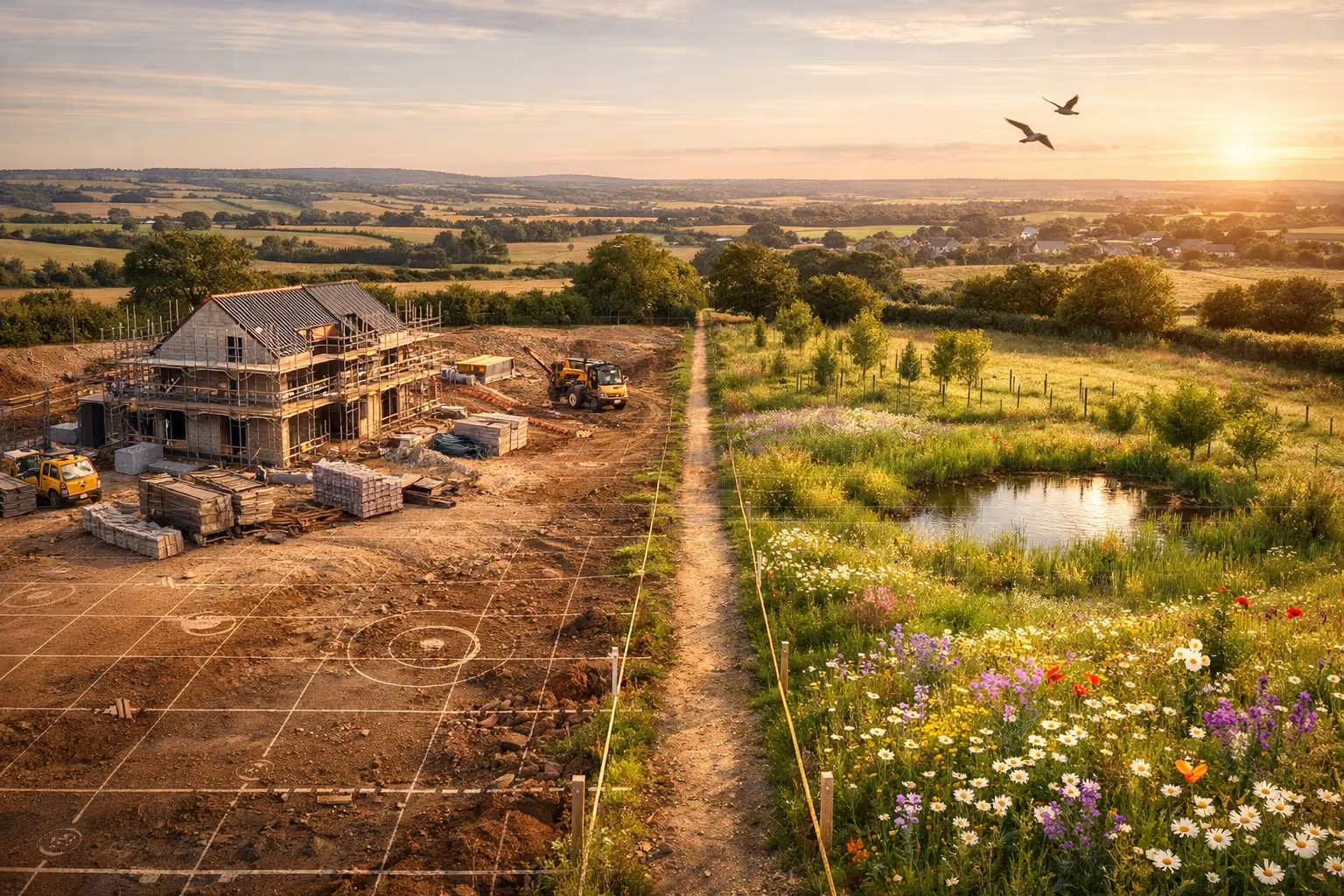
Biodiversity Net Gain is an environmental planning policy designed to ensure that development contributes to the recovery of nature.
Introduced through the Environment Act 2021 and made mandatory for most developments in England from 2024, the policy requires proposals to deliver a minimum 10% improvement in biodiversity value compared with the site’s baseline condition.
To demonstrate this uplift, developers must:
• Assess existing habitats on the site before development begins
• Calculate biodiversity value using the government’s statutory biodiversity metric
• Provide habitat improvements that increase the overall ecological value of the land
These improvements can be achieved in several ways. The most common approach is through on-site habitat creation or enhancement, such as new planting, woodland creation, wetlands, or species-rich grassland.
Where this is not possible, developers can secure biodiversity gains elsewhere by purchasing off-site biodiversity units or, as a last resort, buying statutory biodiversity credits from the government.
The overall aim of BNG is to reverse the long-term decline in wildlife by ensuring that development actively contributes to ecological recovery.
Proposed Biodiversity Net Gain Changes in 2026
Although BNG is still a relatively new policy, the government has already begun reviewing how it operates in practice.
Feedback from developers and planning authorities has highlighted that the current system can create disproportionate costs for smaller developments, particularly when ecological assessments and biodiversity calculations are required for very small sites.
In response, the government is considering a number of reforms that could be introduced during 2026.
The main proposed changes include:
• A new exemption for development sites smaller than 0.2 hectares (around 2,000 square metres)
• Simplified BNG compliance routes for small and medium-sized schemes
• A possible exemption for residential brownfield developments up to 2.5 hectares (currently under consultation)
• Extension of mandatory BNG requirements to Nationally Significant Infrastructure Projects (NSIPs) from May 2026
Together, these changes aim to streamline the system while ensuring that larger developments continue to provide meaningful environmental benefits.
The Proposed 0.2 Hectare Exemption
One of the most widely discussed proposals is the introduction of a 0.2 hectare exemption threshold.
Under the current rules, developments are only exempt from BNG requirements if they affect less than 25 square metres of habitat. In practice, this threshold is extremely low and rarely applies to typical development sites.
As a result, even relatively small schemes often require ecological surveys and biodiversity calculations.
If the proposed reform is introduced, sites below 0.2 hectares would no longer need to demonstrate a 10% biodiversity uplift.
For many small residential projects or compact urban developments, this could remove the need for biodiversity metric calculations and off-site habitat compensation.
Government analysis suggests that if this threshold had been in place when BNG became mandatory in 2024, over 40% of planning applications could have been exempt. This highlights the scale of change the reform could bring to the planning system.
What the 2026 Changes Mean for Current Planning Applications
Despite these proposals, it is important to note that the new rules have not yet been implemented.
As of early 2026, the government is still reviewing consultation responses and preparing the necessary secondary legislation.
Until those regulations are formally introduced, the existing BNG framework remains fully in force. This means planning applications submitted today must still demonstrate a 10% biodiversity net gain, regardless of the size of the development site.
This has created some uncertainty within the development industry. Some developers with sites close to the proposed exemption threshold may be considering delaying submissions in the hope that the new rules come into force.
However, there is currently no confirmed implementation date, and exemptions are unlikely to apply retrospectively. Schemes already submitted or approved will almost certainly continue to be assessed under the current regulations.

.avif)
.avif)
.avif)
.avif)
.avif)
.png)
.png)
%20(1).avif)
.png)
.png)


.avif)
.png)
%20(1).avif)

%20(1).avif)

.jpg)

.avif)